
The Economics of Gym Member Retention: Identifying Churn Signals and Building the Intervention Playbook

It is 5:45 PM on a Tuesday in early autumn. The gym floor is humming with activity. A row of treadmills is mostly full, with the usual suspects grinding out their evening runs. Over in the free weights section, two members are spotting each other on the bench press. The group class instructor is queuing up the warm-up track. Everything looks exactly how a healthy, profitable fitness business should look.
But look closer. Notice the gaps.
Three regulars from the 5:30 PM circuit class are missing. The guy who usually camps out by the squat rack has not swiped his tag since last Thursday. A quiet, expensive leak is happening right under your nose. Members are mentally checking out. They show up a little less often. They skip the stretching block. And within a month, their direct debit will fail or they will send that dreaded cancellation email.
Gym owners spend the bulk of their time and capital trying to acquire new leads. We obsess over Facebook ad costs, lead conversion rates, and trial offers. Meanwhile, the back door is wide open. We accept high cancellation rates as just part of the fitness business. But it does not have to be this way.
If you want to understand how to reduce gym churn, you have to stop treating retention as a feeling. You have to start treating it as an operational science.
Here is the executive summary of what it takes to plug the leak.
- Track visit velocity, not just total visits. A sudden drop in attendance frequency is your loudest warning sign.
- Intervene before the habit breaks. The 90-day mark is a bloodbath for new members. You need automated systems to catch them at day 14.
- Coach behavior dictates long-term adherence. Instructors who build social opportunity and intrinsic motivation keep members far longer than those who just count reps.
- Separate your digital and human playbooks. Let software handle the milestone check-ins, so your staff can handle the high-risk human interventions.
Let’s look at the actual economics of member retention, the early warning signals you are missing, and the exact playbooks you need to run to keep your members for years.
The Brutal Mathematics of Gym Member Churn
The fitness industry has a retention problem. And the numbers are confronting.
According to research tracking over 5,200 individuals in an unsupervised fitness center setting, a staggering 63% of new members will abandon their activities before their third month. Let that sink in. You do the hard work of getting a lead through the door. You sell them a membership. You get them started. Yet more than half of them will be gone before 90 days are up.
Even worse, the same study published in the Journal of Science and Medicine in Sport found that only about 3.7% of members are expected to continue their gym activities for longer than 12 consecutive months.
This is the reality of the business. You are constantly running on a treadmill just to keep your membership base stable. If you have 500 members and an annual churn rate of 40%, you need to sell 200 new memberships a year just to stand still. That is 200 sales tours. That is 200 onboarding sessions. That is thousands of marketing dollars burned just to maintain your current revenue.
When you lower your churn rate by just a few percentage points, the compounding effect on your bottom line is massive. A retained member costs nothing in marketing. They require no sales effort. They just provide pure, predictable recurring revenue.
The Cost of Acquisition Versus Retention
Every operator knows that acquiring a new customer costs more than keeping an existing one. But we rarely run the exact math for our own facilities.
Think about your current Cost of Customer Acquisition (CAC). You have to factor in your ad spend. You have to include the software you use to manage leads. You have to calculate the hourly rate of the staff making follow-up calls and doing facility tours. For many boutique studios and mid-sized gyms, that CAC can easily sit between $100 and $250 per member.
If a member quits in month two, you have likely lost money on them. You have not even recouped the cost of bringing them in. But if you can extend their lifetime from three months to twelve months, their Lifetime Value (LTV) skyrockets. The margins in a fitness business are made in months six, seven, and eight.
| Retention Duration | Total Revenue | CAC Deduction | Gross Profit Margin per Member |
|---|---|---|---|
| 1 Month | $150 | -$150 | $0 (Break Even) |
| 3 Months | $450 | -$150 | $300 |
| 6 Months | $900 | -$150 | $750 |
| 12 Months | $1,800 | -$150 | $1,650 |
| 24 Months | $3,600 | -$150 | $3,450 |
Look at those numbers. A member who stays two years is worth more than eleven members who quit after three months. Therefore, any strategy that extends member lifespan is the highest-leverage work you can do.
The 90-Day Danger Zone
Why do 63% of people quit before month three?
It comes down to a collision between expectation and reality. When a member signs up, their motivation is at an all-time high. They have a specific goal in mind. In fact, the unsupervised setting study noted that weight loss was the most cited motivation for enrolling, while physical training and leisure were cited by only 3% of individuals.
People join because they want to change how they look or feel. They expect rapid results. But human physiology does not work that way. The first few weeks of training are uncomfortable. They experience delayed onset muscle soreness. They have to carve out time in their busy schedules. And when they look in the mirror after three weeks of hard work, they look exactly the same.
This is what we call the progress paradox. The effort required is immediate and high. The visible reward is delayed and slow.
If you leave members to their own devices during this period, their initial burst of motivation will fade. When the motivation drops, the friction of packing a gym bag and driving to the facility suddenly feels overwhelming. They skip one session. Then they skip a whole week. Then they cancel.
The 12-Month Survival Curve
If a member survives the first 90 days, their chances of staying long-term improve. But they are still not safe. Separate research reviewing sustained versus intermittent exercise protocols found that 50% of people who start an exercise program will drop out within 6 months.
At the six-month mark, the reasons for leaving change. It is no longer about the shock of a new routine. It is usually about boredom, a lack of continued progression, or a change in life circumstances.
A studio owner I consult with in Wellington used to think she had a great handle on who was at risk of leaving. She would stand at the door, greet everyone by name, and mentally track attendance. But human memory is flawed. She ran a basic attendance report one Sunday afternoon and realized a dozen of her regular members had slowly faded to once-a-week visits. Then once-a-fortnight. She had not even noticed. By the time she reached out, they had already emotionally checked out. Relying on gut feeling for retention is a fast way to lose good members.
To fix this, you need a systematic approach. You need to understand the psychology behind why people keep coming back to shared exercise environments.
The Psychosocial Drivers of Attendance
We often think members stay because of our shiny new equipment or our beautifully designed locker rooms. They do not. Equipment is a commodity. Culture is a moat.
A fascinating systematic review in adult group fitness classes broke down adherence using the COM-B behavioral framework. This model states that behavior is generated through three interacting components: Capability, Opportunity, and Motivation.
When you apply this to your gym floor, it changes how you view retention entirely.
Perceived Capability (Self-Efficacy)
Capability is not about how strong or fit a member actually is. It is about how capable they feel.
If a new member walks into a high-intensity class and the coach asks them to perform a complex barbell snatch without proper regression options, their perceived capability plummets. They feel embarrassed. They feel out of place. And they are highly likely to cancel their membership.
To improve perceived capability, your programming and your coaches must provide clear, accessible scaling options. Every member needs to leave the facility feeling successful. You want them thinking, “I did that, and I can do it again.”
Social Opportunity (Belonging)
Opportunity refers to the social context of the workout. Are they training in isolation, or are they part of a group?
Groupness and social support are massive predictors of continued class participation. When a member feels like they belong to a specific tribe, they will show up even when they are tired. They do not want to let their workout partners down. They enjoy the banter before class starts.
Instructors and peers shape this social opportunity. A good coach introduces new members to the veterans. A good coach creates partner workouts that force interaction. You cannot manufacture genuine friendships. But you can build an environment where they are likely to form.
Affective Motivation (Enjoyment)
Motivation is the final pillar. And in the context of group fitness, affective motivation is critical. This simply means how the workout makes them feel.
If the workout is a miserable grind every single time, willpower will eventually run out. The experience has to feed forward into positive affective valuation. In simple terms, it has to be fun. Members need to enjoy the process, the music, the energy, and the coaching interaction.
| COM-B Pillar | What It Means for Members | Operational Action for Gym Owners |
|---|---|---|
| Capability | “I have the physical skills and knowledge to do this workout safely.” | Implement a mandatory 3-session beginner onboarding program. Provide visual scaling charts on the gym walls. |
| Opportunity | “I have the social support, time, and resources to attend this class.” | Offer varied class times. Host monthly social events. Train coaches to do physical introductions between new and veteran members. |
| Motivation | “I genuinely enjoy this environment and want to achieve my goals here.” | Gamify attendance with digital badges. Play upbeat, crowd-pleasing music. Ensure coaches use positive reinforcement over negative pressure. |
The Impact of Coaching Behavior on Retention
Your coaches are your primary retention tool. They hold the relationship with the member.
A longitudinal study looking at Portuguese gym-goers engaged in fitness group classes followed 202 participants across a year. The researchers found that the quality of fitness coaches’ behavior is essential in fostering better levels of intrinsic motivation and enjoyment.
The study noted that 40% to 65% of individuals who start exercising drop out over the first 3 to 6 months. Only 30% to 60% of members continue attending in the second year. The ones who stay are the ones whose basic psychological needs are supported by their coaches.
Fostering Intrinsic Motivation
Early in a fitness journey, motivation is usually extrinsic. The member wants to look good for a wedding. They want to lower their blood pressure because their doctor told them to.
Extrinsic motivation gets people through the door. But it rarely keeps them there for years.
Long-term retention requires a shift to intrinsic motivation. The member has to start working out because they genuinely value the activity itself. They love the feeling of getting stronger. They enjoy the mental clarity that comes after a hard session.
Coaches drive this shift. A coach who only yells “burn those calories” is reinforcing extrinsic, outcome-based motivation. A coach who says “notice how much smoother your squat looks today compared to last month” is reinforcing intrinsic, mastery-based motivation. Small changes in language create huge differences in member retention.
The Role of Enjoyment in Exercise Adherence
Enjoyment is a massive factor regarding exercise. If a member hates the process, they will eventually quit. Period.
This does not mean workouts need to be easy. Hard work is satisfying. But the environment must be supportive. The coach needs to know names. They need to understand individual limitations. They need to provide positive reinforcement.
When you hire staff, you should be evaluating their interpersonal behaviors just as harshly as their technical knowledge. A coach with perfect biomechanical understanding but zero empathy will drive members away. A coach who connects with people will keep your gym full, even if their programming is fairly basic.
Programming and Physical Adaptations
While social support and coaching are huge, the actual physical results still matter. Members need to see progress to justify the ongoing expense of a membership.
But how fast do those adaptations happen? And how do different training styles impact retention?
High-Intensity Functional Training (HIFT) Outcomes
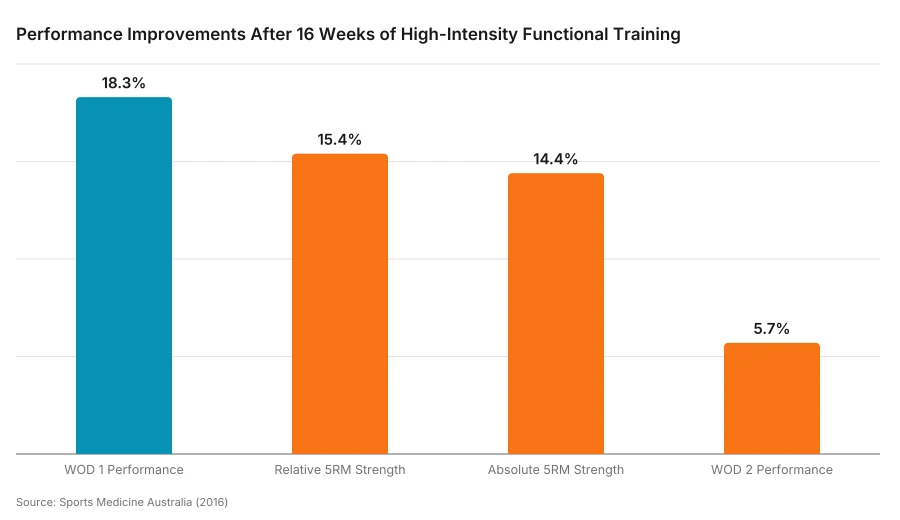
Let’s look at a specific training modality. A 16-week study on High-Intensity Functional Training (HIFT) examined changes in body composition and performance in 26 recreationally active adults.
The results were clear. Performance improvements were noted for all participants. Specifically, performance in their first workout assessment (WOD 1) improved by 18.3%. Their absolute 5-rep max strength improved by 14.4%. Their relative 5-rep max strength improved by 15.4%.
There were also interesting gender differences in body composition. The study revealed a significant gender by time interaction in Bone Mineral Content (BMC). Improvements favored women, who saw a 1.0% increase overall, compared to men who saw a slight decrease of 0.1%. Region-specific analysis indicated that women experienced a 2.5% improvement in trunk BMC.
Why does this data matter for retention?
Because it gives you a timeline. Sixteen weeks of consistent training yields undeniable performance and physiological improvements. If you can keep a member engaged for 16 weeks, they will feel the difference in their strength. They will see the changes in their bone mineral content and body composition.
Your entire retention strategy should be geared toward getting new members across that 16-week finish line.
Managing Expectations and The Progress Paradox
You have to communicate this timeline to your members on day one. Do not let them believe they will see massive changes in three weeks.
Tell them the truth. Tell them the first month is about building the habit. The second month is about neurological adaptations. They will feel stronger because their nervous system is getting more efficient. The third and fourth months are when the structural changes, like muscle hypertrophy and bone density improvements, actually start to happen.
When you set accurate expectations, members are less likely to quit when they hit the inevitable friction of month two.
Special Populations and Retention Variables
Not all members carry the same churn risk. Some demographics are statistically far more likely to cancel than others. If you want to know how to reduce gym churn effectively, you have to know who is most at risk.
A pragmatic follow-up study looking at long-term exercise adherence after public health training in at-risk adults provides excellent insight. The study followed 214 adults who received a 12-week training intervention.
The attrition rate was brutal. Fully 84% (179 people) dropped out. During the 12-month follow-up, only 48% of the remaining individuals reported long-term exercise adherence.
Age and Baseline Activity Levels
The researchers looked at the predictors of long-term adherence. The biggest factor? Participation in sport activities at baseline. Members who had a history of playing sports were significantly more likely to stick with the program (adjusted odds-ratio of 4.22).
Conversely, long-term non-adherence was strongly associated with low education (adjusted odds-ratio of 3.27) and being under 50 years of age (adjusted odds-ratio of 3.53).
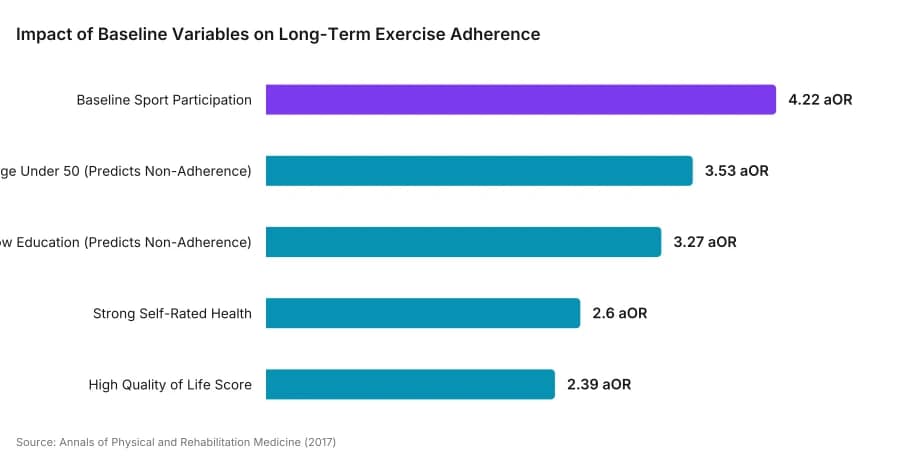
This data tells a compelling story. If a new member joins your gym and they have zero history of playing sports or engaging in physical activity, they are a massive flight risk. They do not have the ingrained habits or the physical literacy of someone who played team sports in their twenties.
You cannot treat these populations the same way. The ex-athlete might just need a basic orientation and a workout plan. The true beginner needs high-touch accountability, frequent check-ins, and a heavily modified introductory program.
Health, Quality of Life, and Long-Term Adherence
The same study found that strong self-rated health (aOR 2.60) and high quality of life (aOR 2.39) were also predictors of long-term adherence.
People who feel good generally keep exercising. People who feel terrible often struggle to maintain consistency. This creates a vicious cycle. Those who need exercise the most are often the hardest to retain.
Your onboarding process needs to identify these risk factors early. If a member flags on their intake form that they are completely sedentary and dealing with chronic stress, your staff needs to tag their profile. They require a completely different intervention playbook.
Identifying the Early Warning Signals
You cannot save a member if you do not know they are leaving. By the time someone sends the cancellation email, the decision was made weeks ago. You have to catch the behavioral changes that precede the cancellation.
Visit Velocity and Attendance Drops
Total visits are a vanity metric. If a member visits 10 times in a month, that sounds great. But if they visited 8 times in the first two weeks and only 2 times in the last two weeks, they are currently churning.
You need to track visit velocity. This is the rate of change in a member’s attendance frequency. A 50% drop in weekly attendance is your loudest warning sign. If a member who usually trains four days a week drops to two days a week, red flags should be going off in your management software.
Do not wait for them to hit zero visits. Intervene when the velocity slows down.
Changes in Booking Behavior
For class-based studios, watch how members book their sessions. Engaged members book days in advance. They have a set routine.
When a member starts slipping, their booking behavior becomes erratic. They book late. They late-cancel more frequently. They start showing up to random time slots instead of their usual 6:00 AM crew.
This indicates that exercise is no longer a fixed priority in their schedule. It has become an afterthought squeezed in when convenient. This is a precursor to a full drop-off.
The Silent Fade
Then there are the members who still show up, but they have quietly disengaged. They stop talking to the coaches. They leave class the second the final buzzer sounds. They skip the cool-down. They stop logging their workout results.
This is where your software cannot save you. Your coaches have to be trained to spot the silent fade. They need to read body language and notice when a usually energetic member becomes withdrawn.

Transform Your Fitness Practice
Join thousands of Kiwis who’ve found their fitness companion.
No downloads, no hassle — just results.
The Intervention Playbook: Digital Automation
Once you identify a member at risk, what do you actually do? You need an intervention playbook. And because you are busy running a business, the first layer of this playbook must be automated.
You cannot manually monitor hundreds of members. You need your software to do the heavy lifting.
Milestone Triggers
Automation should not only be used for negative events. You should automate positive reinforcement.
Set up triggers in your software for attendance milestones. When a member hits their 10th visit, they get an automated email from the owner congratulating them on building the habit. When they hit their 50th visit, they get a branded t-shirt waiting for them at the front desk. When they hit their 100th visit, they get a shoutout on the gym’s social media.
We call this the 10-50-100 workflow. It builds immense goodwill without requiring daily admin work from your team.
Absence Alerts
The core of automated retention is the absence alert. You should have a sequence that fires automatically based on days since the last visit.
- Day 7: A light, automated SMS. “Hey [Name], haven’t seen you this week. Hope everything is good. Let us know if you need help adjusting your training schedule.”
- Day 14: An automated email offering value. “Hey [Name], taking a break is totally normal. Here is a quick 15-minute mobility routine you can do at home to stay loose until you get back in the gym.”
- Day 21: A task is created for a human staff member to make a phone call. Automation stops here. It is time for a real conversation.
This sequence catches the majority of members who just got busy at work and need a gentle nudge to get back on track.
Billing Failures
Failed payments are a massive source of involuntary churn. A member’s credit card expires. The payment bounces. They feel embarrassed, and they just never come back.
Your billing software must have an automated dunning process. It should retry the card strategically and send polite, low-friction emails with a simple link to update payment details. Do not make them call the front desk to fix a billing issue. Make it simple.
The Intervention Playbook: Human Touch
Automation handles the low-hanging fruit. But when a member hits 21 days absent, or when they explicitly request a cancellation, you need the human touch.
This is where gym owners often fail. We are afraid of the awkward conversation, so we just process the cancellation and move on. You have to train your staff to lean into these moments.
Front Desk Engagement
Your front desk staff are your first line of defense. They should know exactly who is returning from an absence.
If a member walks in after a three-week hiatus, the front desk software should flag it. The staff member needs to acknowledge it positively. “Hey Sarah. So great to see you back. We missed you in the evening classes.”
Do not guilt them. Do not ask them where they have been. Just make them feel incredibly welcome. The friction of returning after a break is high. Your team needs to lower it by making the environment warm and accepting.
Coach-Led Check-Ins
For higher-tier memberships or personal training clients, the intervention must come from the coach.
If a member’s visit velocity drops, the coach should send a personalized audio message or a quick video text. “Hey John, noticed you’ve had to miss a few sessions lately. I know work has been crazy for you. Let’s scale back the intensity this week and just focus on moving well. See you Thursday?”
This works because it offers a solution. It acknowledges the member’s stress and removes the pressure of having to perform a brutal workout upon returning.
The Win-Back Call
If a member reaches the point of requesting a cancellation, you need a structured win-back protocol.
Do not argue with them. Seek to understand. Call them and ask for honest feedback. “I completely understand you need to pause your membership. Before I process that, could you share what made you decide to stop? We are always trying to improve the facility.”
Often, they will reveal a solvable problem. They might say the evening classes are too crowded. You can respond, “I totally get that. Did you know we just added two new 7:00 PM classes that are much quieter? If I comp your next two weeks, would you be willing to try them out before making a final decision?”
Even if you only save one out of ten cancellations with this script, the financial return over a year is massive.
Staffing and Operationalizing Retention
A playbook is useless if no one runs the plays. You cannot just tell your staff “we need to focus on retention.” You have to operationalize it.
Assigning Ownership
If everyone is responsible for retention, no one is responsible for retention. You need a designated person who owns the churn metric.
In a small studio, this might be the owner. In a mid-sized facility, it should be a lead coach or a dedicated member success manager. This person’s job is to check the at-risk reports every single morning. They ensure the automated emails are firing correctly. They assign human follow-up tasks to the coaching team.
Key Performance Indicators for Retention Staff
Sales staff are measured on new contracts. Retention staff should be measured on saves.
Track how many at-risk members were contacted each week. Track how many of those contacted members returned for a workout within 7 days. Track the save rate on cancellation requests.
If you want your team to take retention seriously, tie a portion of their compensation to it. Offer a bonus structure based on maintaining a churn rate below a specific threshold. When coaches realize they get paid more when members stay, they suddenly become very invested in social belonging and affective motivation.
Training the Team
You have to train your coaches on behavioral psychology. They spend hours learning anatomy and biomechanics. But they spend zero hours learning how to handle a frustrated member who wants to quit.
Run role-playing scenarios in your staff meetings. Have one coach play a member who has not seen any weight loss results in two months. Have the other coach practice shifting the conversation from outcome goals to behavioral goals. Teach them how to handle the progress paradox in real-time on the gym floor.
Designing a Retention-First Onboarding Experience
The best way to reduce gym churn is to prevent the behavioral decline from starting in the first place. And that begins on day one.
Your onboarding process dictates the member’s long-term trajectory. If you just hand them a key tag and point them to the treadmills, you are setting them up to be part of the 63% who quit before month three.
The First 7 Days
The first week is about removing anxiety. The member needs to learn where to park. They need to know how to use the lockers, how to book a class, and where the water fountain is.
Do not overwhelm them with complex macro-nutrient calculations on day two. Just focus on logistical comfort. Send a welcome video from the owner. Introduce them to three other members. Make the environment feel safe.
Goal Setting and Baseline Metrics
During the first two weeks, you must establish baseline metrics. As the research showed, members who are motivated purely by weight loss have high abandonment risk. You need to anchor them to performance metrics.
Run a baseline assessment. How many push-ups can they do? What is their resting heart rate? How is their mobility?
Document these numbers. When the member hits the month-two friction point and complains that the scale has not moved, you can pull out the baseline data. “The scale might be the same, but you just did 15 push-ups today, and you could only do 4 when you started. You are getting significantly stronger.”
This shifts the focus back to perceived capability and intrinsic motivation.
Integrating into the Community
Finally, force social integration. Do not leave it to chance.
Pair new members with a veteran buddy for their first few group classes. Host a monthly “new member coffee” after the Saturday morning workout. The faster a new member learns the names of five other people in the facility, the faster their churn risk plummets.
The Economics of Caring
Reducing gym churn is not about locking members into iron-clad contracts. It is not about tricking them with complex cancellation policies. Those tactics might save a month of revenue, but they destroy your brand reputation.
True retention is the economics of caring. It is about understanding the psychosocial drivers of human behavior. It is knowing that a 50% drop in attendance is a cry for help. It is training your coaches to build intrinsic motivation, and using technology to catch the people who are quietly fading away.
You have to build the intervention playbooks before you need them. You have to map out the email sequences, write the phone scripts, and train your staff on exactly what to do when a member hits day 14 of an absence.
The math is undeniable. Keeping the members you already have is the fastest, most profitable way to grow a fitness business. You do not need more leads. You just need to stop losing the people who already trusted you enough to sign up.
If you want to automate the heavy lifting of member engagement, milestone tracking, and habit building, PATO’s AI companion stays on top of the data so you don’t have to. Your owner dashboard flags the at-risk members, while the gamification engine rewards their streaks to keep them motivated. Check it out.

