Why Catering to Your Fittest Members Won’t Fix Gym Churn
Running a weekly 5K club for your fittest members does absolutely nothing for your retention. It just gives people who were never going to quit another excuse to hang out.
Most gym operators build communities backward. They look at who shows up the most and build sub-groups to reward them. But if you want to fix your member churn rate, your efforts need to target the people quietly slipping out the back door. As we head into the early autumn back-to-routine season, you have a brief window to reset habits and win back lapsed members. You do not need another high-intensity lifting club. You need targeted social support.
Gym community building is often treated as a fluffy concept. It shouldn’t be. When designed correctly, a micro-community is a highly functional retention tool. The trick is knowing which demographics actually need the intervention, and which ones are just draining your staff’s time.
Who actually needs the ‘belonging’ factor?
The highest-churn demographics in most facilities are beginners in their first six months and older adults returning to exercise. These groups rarely quit because the programming is bad. They quit because they feel invisible.
Look at the research. A nine-year longitudinal study of nearly 2,000 older adults found that specific social support for physical activity directly predicts long-term adherence. Every small unit increase in perceived support resulted in an extra 11 minutes of physical activity per week. That adds up fast over a billing cycle.
Even more striking, the same researchers noted that adults over 60 who had the company of family or friends during physical activity were significantly more likely to meet health guidelines.
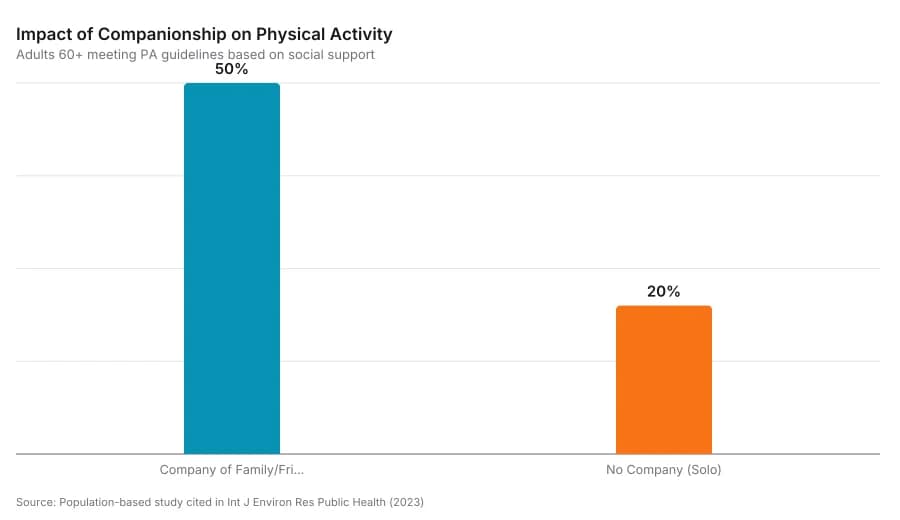
This demographic does not need to hit new personal bests on the platform. They need a reason to show up on a rainy Tuesday. If they don’t have a friend waiting for them, they stay home. And when they stay home for three weeks straight, they cancel.
The five forms of social support
A micro-community is not just a WhatsApp group. To work, it has to provide functional support. A study analyzing over 500 adults broke down group exercise membership into five distinct forms of functional social support. If your micro-community doesn’t provide these, it is just a mailing list.
- Emotional: Creating a feeling of “I belong here.”
- Validation: Showing members that “Other people struggle with this too.”
- Informational: Providing clear guidance on “Here is how you do this safely.”
- Instrumental: Practical help, like sharing a ride to the facility.
- Companionship: The simple joy of “I am looking forward to seeing my friends.”
For women in the study, validation and companionship were massive drivers of creating an “exercise identity.” When members identify as someone who exercises, they stop being a flight risk. This is exactly what we see during the notorious month two to six slump. If they haven’t built an exercise identity by month three, they are gone.
Evaluating the management overhead
So how do you choose which groups to build? You have to weigh the retention upside against the operational drag.
Back in my Grey Lynn studio days, I tried to launch an Olympic lifting club. It sounded great on paper. The problem? The only people who joined were the six guys who already trained five days a week. My member retention rate did not budge. I was spending three hours of unpaid admin a week to entertain my most loyal customers, while completely ignoring the quiet beginners who were actually canceling their direct debits.
Compare that to a structured intervention like the Walk Your Heart to Health program. This 32-week walking group intervention proved highly effective for retaining diverse, low-to-moderate income populations. It worked because the group cohesion was tied directly to a shared, accessible task. But running a 32-week program takes serious staff hours. You need to pick your battles.
| Micro-Community Type | Target Demographic | Management Overhead | Churn Reduction Impact |
|---|---|---|---|
| Advanced Barbell Club | Veterans (1+ years) | High (Programming, Coaching) | Low (They weren’t quitting anyway) |
| Beginner Mobility Group | New members (0-6 months) | Medium (Staff led, simple programming) | High (Builds early exercise identity) |
| 55+ Walking/Coffee Club | Older adults | Low (Member led, minimal equipment) | Very High (Provides companionship support) |
Notice the trend. The most effective gym member experience initiatives often require the least technical coaching. They just require space, a regular time slot, and a bit of initial coordination.

Run your gym smarter.
The complete AI-first OS for owners and members.
Good software, zero BS.
Identifying the invisible flight risks
You cannot manage community building by gut feel. If you rely on who says hello at the front desk, you will miss the people slipping out the back.
You need to identify every at-risk member before their attendance drops to zero. This is where cultivating a community hub intersects with your data. If a member’s visit frequency drops by half, that is your trigger to intervene. Invite them to a low-barrier micro-community. “Hey, I noticed you haven’t been hitting the heavy classes lately. A few of the members are starting a Thursday morning stretch and coffee group. Want me to add you to the list?”
That single message provides emotional support, validation, and companionship all at once. Huge difference.
Using tech to scale social support
The goal is connection, not complexity. Good gym member engagement happens when people can interact easily. If your staff has to spend three hours a week manually texting reminders or updating spreadsheets, the micro-community will die the minute things get busy.
This is where a proper member engagement app for gyms becomes necessary. Once you have the data sorted, you can automate the busywork. Let the software track the streaks, manage the group chats, and flag the members who are dropping off. That frees your coaches up to actually talk to people on the floor.
Community is not magic. It is just a highly effective retention mechanic when pointed at the right people. Stop spending all your energy on the members who practically live at your facility. Build bridges for the ones standing near the exit. If you want to see how the right technology can help you track engagement, identify flight risks, and automate the daily management so your coaches can actually coach, book a PATO demo today.